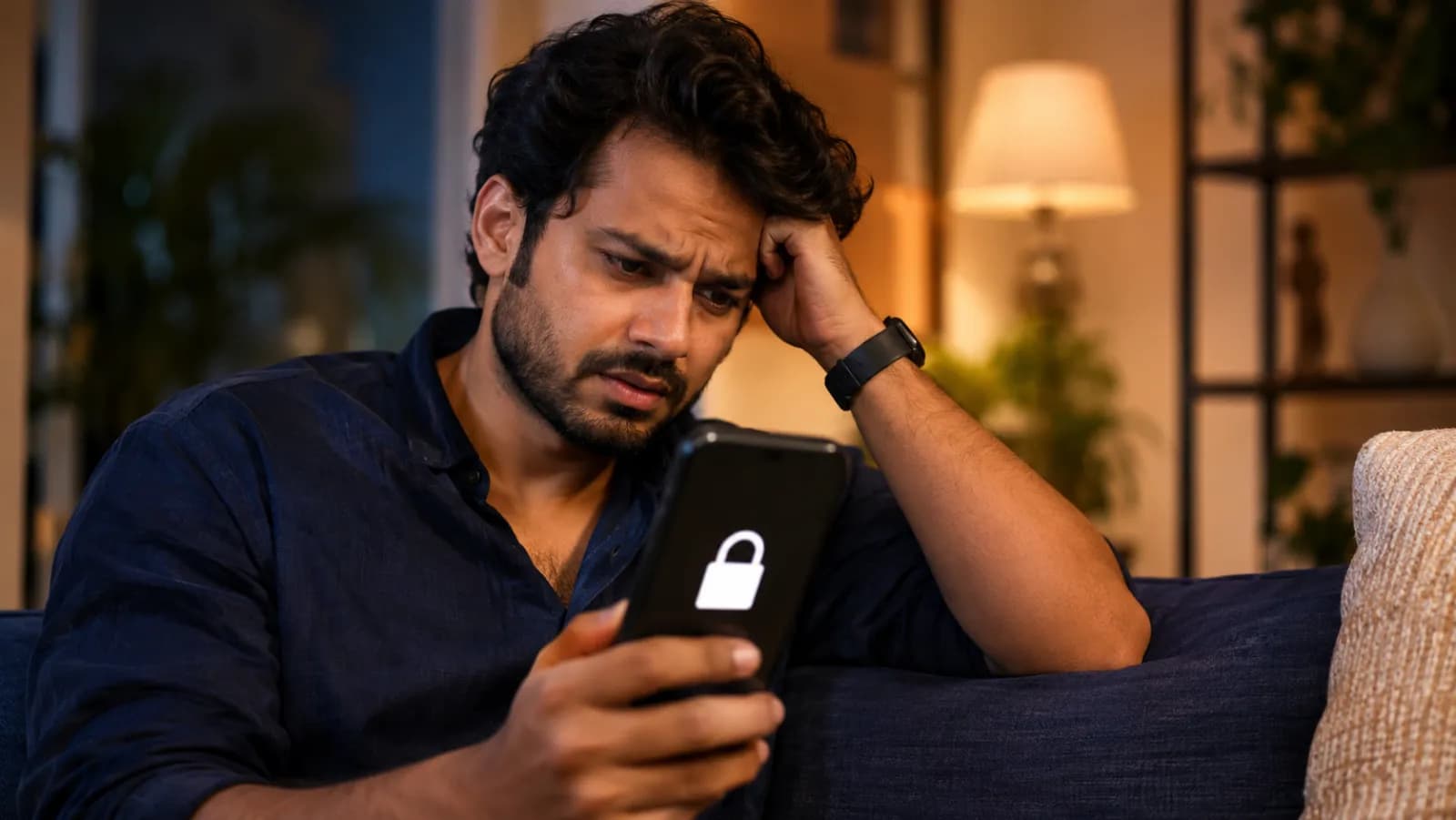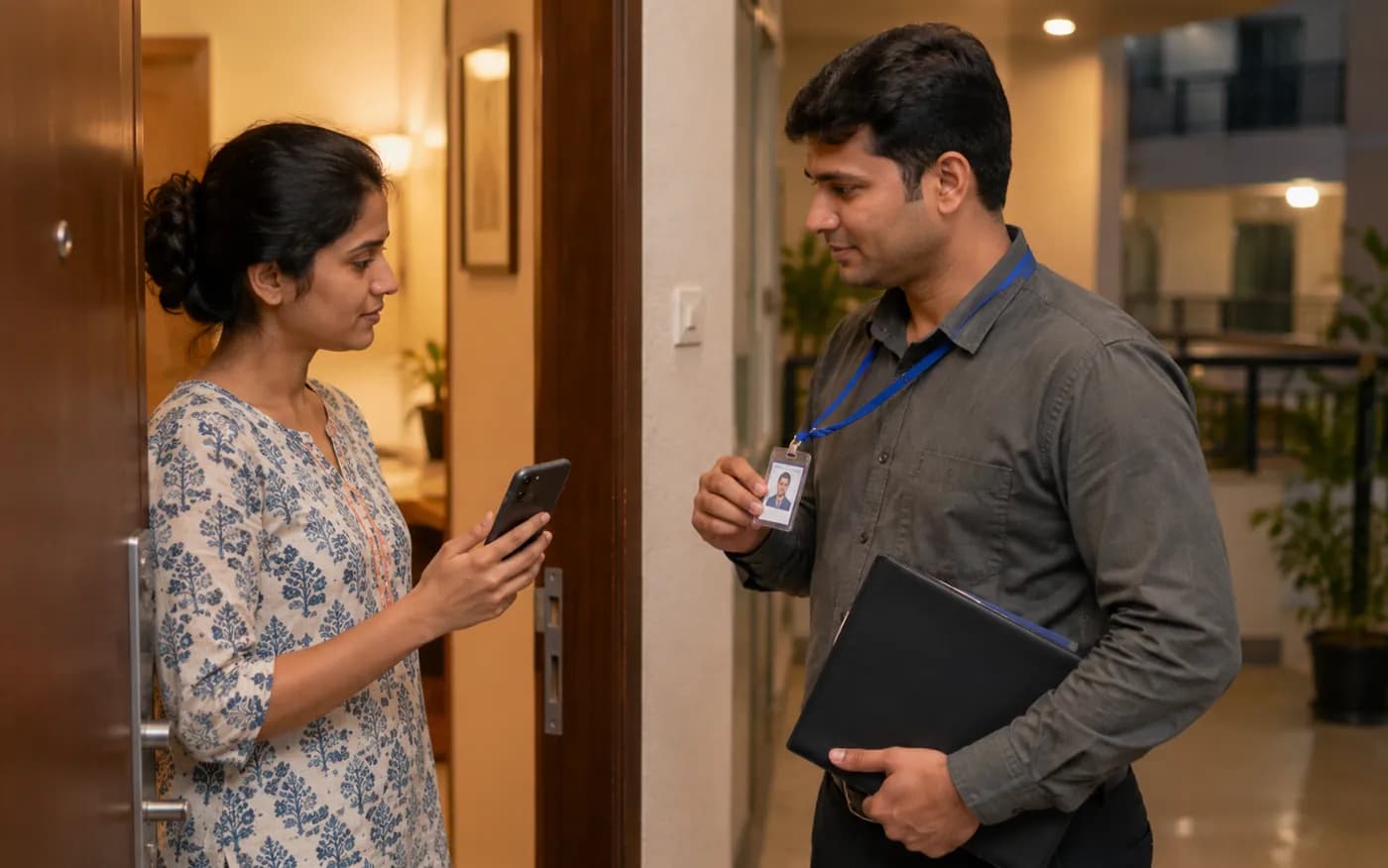
If a recovery agent is at your home, stay calm, keep the door between you, and ask for an identity card and the lender's authorisation letter. You do not have to let the agent in or hand over cash. This guide is for borrowers and family members facing a visit right now, and gives the order to do things in. If anyone is threatening you or refusing to leave, call 112 first.
What to do when a recovery agent is at home: minute by minute
- 1Check you are safe. Keep children and elderly relatives in another room. If the agent is aggressive, call 112.
- 2Stay at the door. Say calmly: "Please show your ID card and the lender's authorisation letter."
- 3Photograph both documents. Note the agency name, agent's name, phone number and any vehicle number.
- 4Ask which lender and which loan account the visit is about. Check the account number against your own papers.
- 5Say what you will do next, in one line: "I will contact the lender in writing today." You need not explain your finances.
- 6Do not sign anything or pay cash. Ask for the lender's official payment link or account if you decide to pay.
- 7Ask the agent to leave once the conversation is over. If they stay, record the time and call 112 if you feel unsafe.
- 8Within the hour, write down what was said and by whom, and save any photos or video.
What a recovery agent may and may not do at your home
RBI allows lenders to recover overdue money, so a polite visit is not by itself illegal. The limits are about how it is done. New RBI Directions dated 6 August 2026 restate these limits in more detail for banks, NBFCs and housing finance companies, and take effect on 1 January 2027.
| Allowed | Not allowed |
|---|---|
| A visit between 8 am and 7 pm | A visit before 8 am or after 7 pm, unless you asked for it |
| A civil talk about the overdue amount | Threats, abuse or shouting to draw neighbours |
| Discussing the loan with you or your guarantor | Discussing your loan with neighbours or visitors |
| Giving you a notice from the lender | Entering without your permission |
| Collecting money with a proper receipt | Taking household items for an unsecured loan |
If the loan is secured, such as a vehicle loan, the lender may have rights over that asset under the agreement. Even then, an agent cannot use force or threats. Our guide on whether agents can take gold, furniture or a bike sets out the difference.
What to say to the agent
Short and polite works best. You are not refusing the debt, and you are not agreeing to anything on the doorstep. You can use these lines:
- "Please show your ID and the lender's letter before we talk."
- "I will not discuss this in front of my family or neighbours."
- "I will write to the lender today. Please note that all further contact should be in writing."
- "I am not paying cash. Please share the lender's official payment details."
What not to do
- Do not push, hit or threaten the agent, even if provoked. It can turn your complaint into a case against you.
- Do not give original documents, cheques or blank signed papers.
- Do not pay into an agent's personal UPI ID or bank account.
- Do not ignore a genuine court or lender notice just because the visit upset you.
- Do not lock anyone in or take the agent's phone. Call the police instead.
After the agent leaves: three things to do today
- 1Save the evidence: photos, call logs, and notes with the date and time. Our guide on keeping evidence explains what holds up best.
- 2Email the lender's grievance redressal officer, describe the visit and ask for the agency's details in writing.
- 3If the agent threatened you, entered your home or took anything, file a police complaint as well.
If the lender does not resolve your complaint within 30 days, you then have 90 days to go to the RBI Ombudsman at cms.rbi.org.in. Harassment is common: in our own enquiry data, 58% of Hyderabad borrowers and 63% of Bengaluru borrowers report it. You are not the only one, and you do have options.
Conclusion: when a recovery agent is at home, follow the order
When a recovery agent is at home, safety comes first, then ID, then details, then a written complaint. The visit does not change what you owe, and it does not take away your rights. If visits keep happening and you cannot repay in full, our legal experts can review your case, deal with the lender in writing and explore a settlement.
Frequently asked questions
What should I do if a recovery agent comes to my house?
Stay calm, talk at the door, and ask for an ID card and the lender's authorisation letter. Photograph both, pay no cash, sign nothing, and write to the lender the same day. Call 112 if you feel unsafe.
Do I have to let a recovery agent into my home?
No. A recovery agent has no right to enter your home without your permission. You can speak at the door or at another place you choose.
Can I ask a recovery agent to leave?
Yes. Once you have noted the details, you can ask the agent to leave. If they refuse or threaten you, call 112 and note the time. Do not use force yourself.
Should I pay the recovery agent to make them go away?
Do not pay cash or use a personal UPI ID under pressure. If you choose to pay, use the lender's official channel and keep a receipt. Payment made to the wrong person may not reduce your dues.
Can a recovery agent come at night?
No. Visits are allowed only between 8 am and 7 pm, unless you have expressly asked for another time. Note the time and include it in your complaint.
Get help with this
Loan settlement in major cities
- Loan settlement in Hyderabad
- Loan settlement in Bengaluru
- Loan settlement in Chennai
- Loan settlement in Mumbai
- Loan settlement in Delhi
- Loan settlement in Pune
- Loan settlement in Kolkata
- Loan settlement in Ahmedabad
- Loan settlement in Vijayawada
- Loan settlement in Visakhapatnam
- Loan settlement in Kochi
- Loan settlement in Madurai
- Loan settlement in Hubli-Dharwad
Official sources
- Written by
- Raj
- Category
- Anti-Harassment
- Read time
- 7 min
- Published
- 2 November 2026
- Updated
- 2 November 2026
Free case review
Struggling with loan EMIs or recovery calls?
Our legal experts review your loans and explain your settlement options, at no cost.
Get a free case review