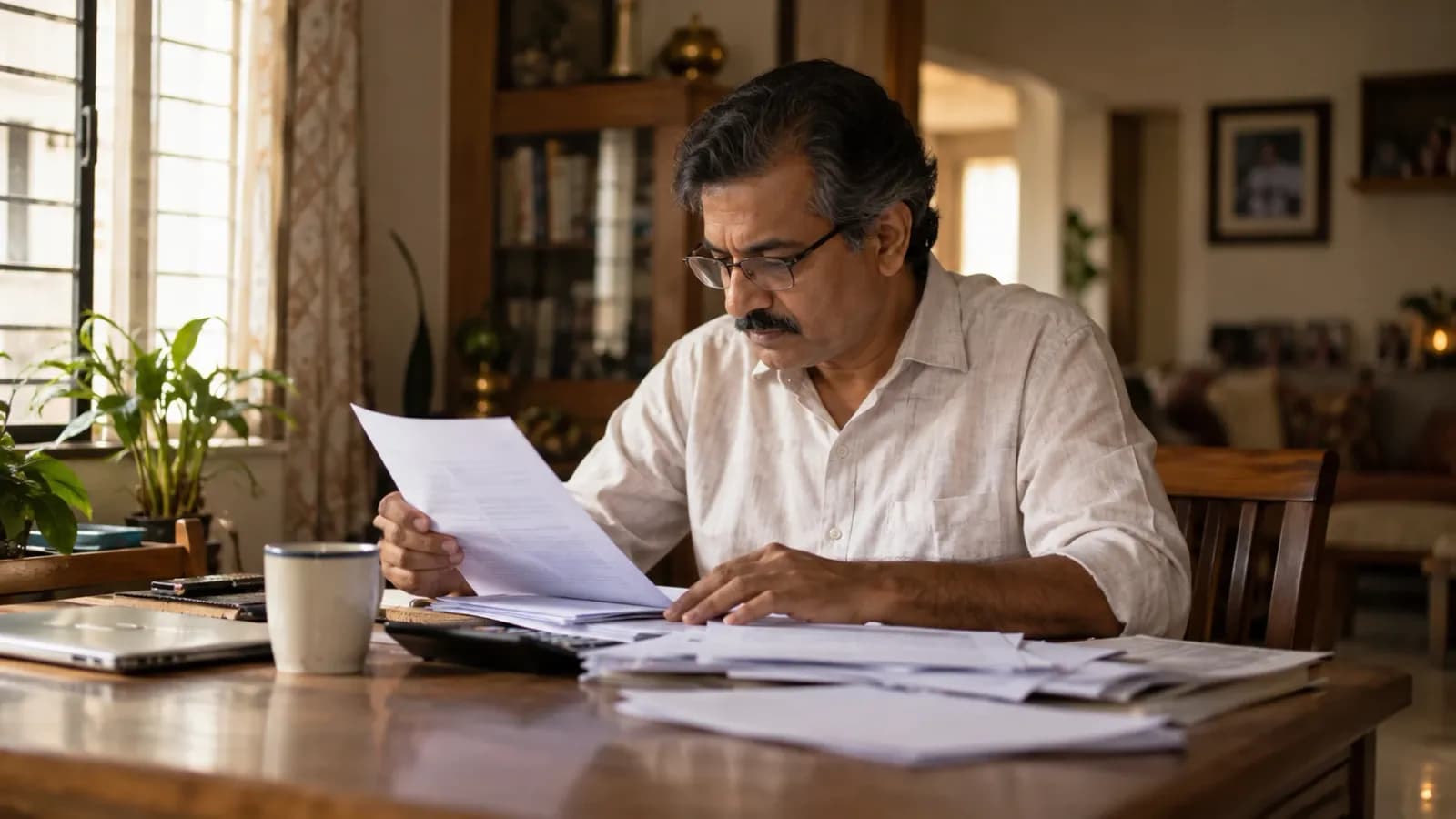
If your credit card bill is not paid, the card issuer charges a late fee plus interest on the entire balance, reports the account as past due once it is more than 3 days late, and blocks the card. If the minimum amount due stays unpaid for 90 days from the due date, the account becomes a non-performing asset (NPA), and the bank may send a legal notice, start a case or offer a settlement. Unpaid credit card debt is a civil matter: you cannot be jailed only for being unable to pay. This guide is for cardholders who have missed one or more payments and want to understand the consequences and the safest way to settle.
Credit card bill not paid: what happens month by month
| Stage | What the bank does | Effect on you |
|---|---|---|
| Due date missed | Late payment fee; interest on the full balance; GST on fees and interest | Balance starts growing |
| More than 3 days late | Reports the account as past due | CIBIL score drops |
| 30–60 days | Card blocked, limit cut, recovery calls and messages | Further score damage |
| Before default reporting | Sends you a 7-day notice | Last chance to pay or agree a plan |
| 90 days after the due date | Account classified as NPA, full balance demanded | Legal notice, case or settlement offer |
How fast an unpaid credit card balance grows
Card interest is charged monthly and is far higher than on a personal loan. As an illustration, on an unpaid balance of ₹1,00,000 at a monthly rate of 3.5%, interest alone is ₹3,500 a month, and 18% GST adds another ₹630. That is about ₹4,130 a month before any late fee, and the next month's interest is calculated on the higher balance. Rates vary by card, so check the rate printed on your statement.
Is paying the minimum amount due enough?
Paying the minimum due keeps the account regular, so you are not reported as a defaulter. But interest is still charged on the entire outstanding balance, so the debt can take years to clear. Since 2024, RBI has required every card statement to warn you that paying only the minimum stretches repayment over months or years with compounded interest.
Can a bank file a case for an unpaid credit card bill?
Yes, a bank can take legal action to recover unpaid credit card dues. The usual routes are a legal notice demanding the full balance, arbitration if your card agreement has an arbitration clause, a civil recovery suit, or an invitation to settle at a Lok Adalat. Banks often list old card accounts at National Lok Adalats, which are held on the second Saturday of March, May, September and December.
Can I go to jail for credit card debt in India?
Not for being unable to pay. Criminal proceedings are possible only if you paid the bill with a cheque that bounced, under Section 138 of the Negotiable Instruments Act, or if the bank can show fraud, such as getting the card with fake documents. A recovery agent who threatens you with arrest for non-payment alone is breaking RBI's rules, and you can include that threat in a complaint.
Your rights when credit card dues are unpaid
- Recovery calls only between 8 am and 7 pm, without threats, abuse or calls to your family and colleagues.
- Seven days' notice before you are reported as a defaulter to a credit bureau.
- An itemised statement of the outstanding amount, interest and charges on request.
- A credit report update within 30 days after you settle the dues.
- A complaint to the RBI Ombudsman if the bank does not resolve your complaint within 30 days.
Credit card debt settlement in India: your options
| Option | How it works | Effect on CIBIL |
|---|---|---|
| Balance conversion to EMI | The bank converts the outstanding amount into fixed EMIs at a lower rate | Neutral if paid on time |
| Repayment plan | The bank stops late fees and agrees a schedule | Recovers as you pay |
| One-Time Settlement | You pay an agreed lump sum or a few instalments; the rest is waived | Reported as 'Settled' for some years |
| Pay in full | Clear the whole balance, including charges | Best long-term outcome |
How credit card settlement works, step by step
- 1Stop using the card so the balance stops growing.
- 2Ask the bank for a full statement of the outstanding amount, interest, fees and GST.
- 3Write to the bank explaining your hardship and request a settlement or an EMI plan.
- 4Get the settlement offer in writing, showing the card number, the settled amount, the payment dates and that the balance is waived.
- 5Pay only into the bank's official account or card number and keep every receipt.
- 6Collect a No Dues letter after the final payment and check your credit report 30–60 days later.
Checklist: what a credit card settlement letter must show
- Your name and the last 4 digits of the card.
- The total outstanding and the agreed settlement amount.
- Exact payment dates and the account to pay into.
- A statement that the remaining balance is waived once you pay.
- A commitment to issue a No Dues letter and update the credit bureaus.
A settled card is reported as 'Settled', not 'Closed', which lowers your CIBIL score for some years. If you later pay the waived amount, you can ask the bank to update the status to 'Closed'. Most large issuers, including HDFC Bank, SBI Card, ICICI Bank and Axis Bank, consider settlements under their own policies, and our credit card settlement services can help you prepare the request.
Conclusion: an unpaid credit card bill gets more expensive every month
When a credit card bill is not paid, interest, GST and fees grow the balance faster than almost any other debt, and the 90-day NPA mark brings legal steps. Act early: convert the balance to EMIs if you can, or negotiate a written credit card settlement if you can't. If recovery calls cross the line, complain in writing and keep the evidence.
Frequently asked questions
What happens if I don't pay my credit card bill for 6 months?
The account becomes an NPA once the minimum due has been unpaid for 90 days. By six months, the bank will usually have blocked the card, reported the default to the credit bureaus, recalled the full balance and sent a legal notice or a settlement offer.
Can I go to jail for not paying a credit card bill in India?
No, not for being unable to pay. It is a civil matter. Criminal proceedings are possible only for a bounced cheque under Section 138 of the Negotiable Instruments Act, or for fraud such as using fake documents to get the card.
Can credit card debt be settled in India?
Yes. Banks offer One-Time Settlements on overdue credit cards under their own board-approved policies. Get the terms in writing before paying, pay only the bank, and collect a No Dues letter after the final payment.
Does the bank have to inform me before reporting a default?
Yes. Under RBI's credit card directions, the card issuer must give you a 7-day notice before reporting you as a defaulter to a credit information company.
How long does a settled credit card stay on my CIBIL report?
The payment history and 'Settled' status stay on your report for several years. Your score improves over time with on-time payments on other credit, and the status can change to 'Closed' if you later pay the waived amount.
Should I use a credit card settlement company?
You can settle directly with the bank. A settlement company can help with negotiation, paperwork and harassment, but choose one that never asks you to pay settlement money into its own account. Every payment should go only to the bank.
Official sources
- RBI Master Direction: Credit Card and Debit Card – Issuance and Conduct, 2022 (as amended)
- RBI: Framework for Compromise Settlements and Technical Write-offs (8 June 2023)
- RBI Complaint Management System (Integrated Ombudsman Scheme)
- TransUnion CIBIL
- India Code: Negotiable Instruments Act and SARFAESI Act
- Written by
- Legal Savvy Editorial Team
- Reviewed by
- Legal team
- Category
- Loan Settlement
- Read time
- 8 min
- Published
- 11 October 2026
- Updated
- 11 October 2026
Free case review
Struggling with loan EMIs or recovery calls?
Our legal experts review your loans and explain your settlement options, at no cost.
Get a free case review